

Tomzn TOCT1 4P 2NO 2NC AC Modular Contactor
Product Overview
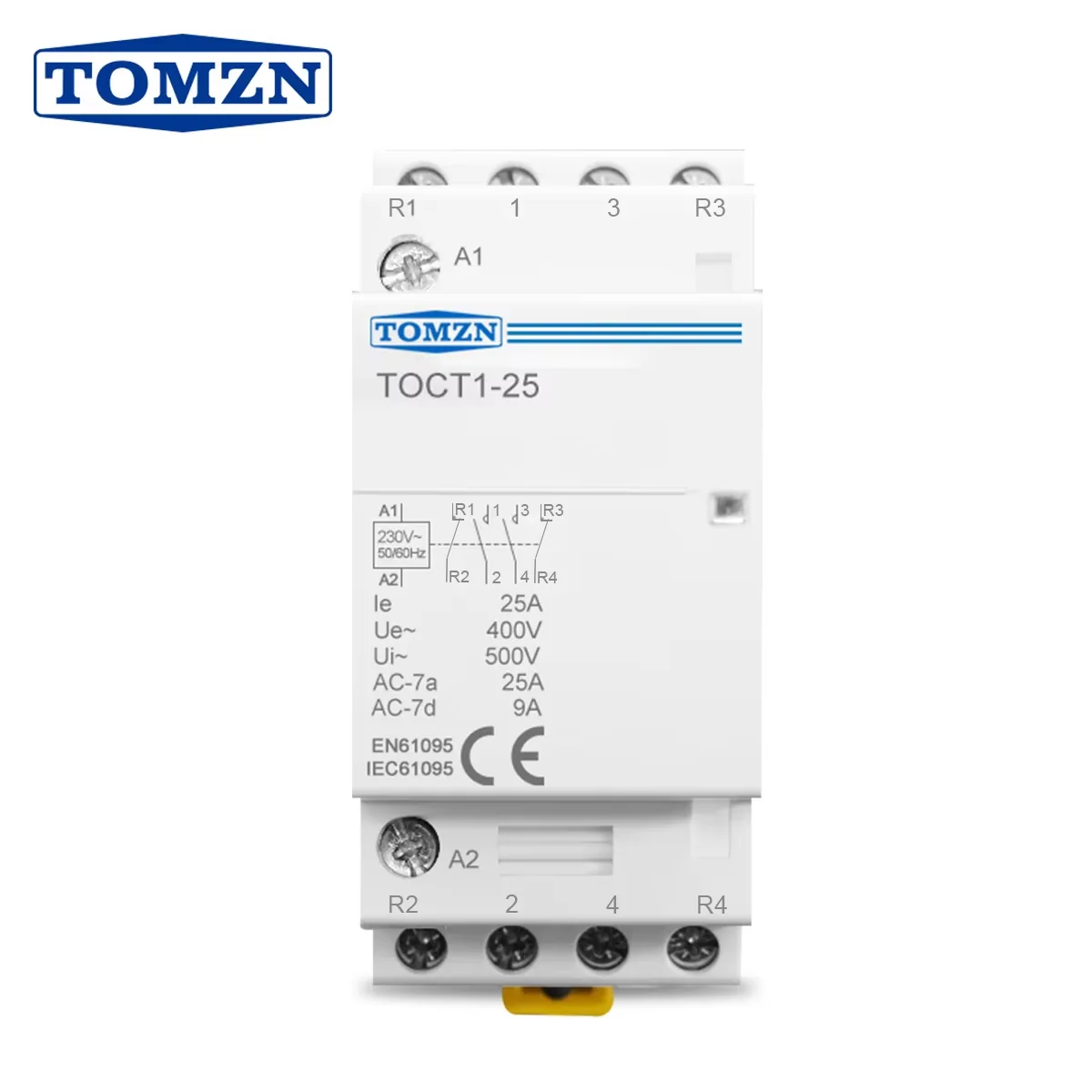
The Tomzn TOCT1 2NO 2NC AC Contactor is a modular electrical switching device designed to control compatible AC circuits in residential and light commercial electrical installations. It features a four-pole contact arrangement with two Normally Open (2NO) contacts and two Normally Closed (2NC) contacts.
A modular contactor allows an electrical load to be switched through a separate control circuit rather than relying only on a manual switch. When the contactor coil receives its specified control voltage, the internal contacts change their state and operate the connected circuit according to the contact configuration.
The Tomzn TOCT1 series is designed for DIN rail installation in distribution boards and electrical enclosures. Its compact modular construction makes it suitable for applications where automatic or remote switching of electrical loads is required.
This product is intended for compatible AC applications. The exact current rating, coil voltage, and operating specifications depend on the selected TOCT1 variant and should be checked on the actual product label.
Key Features
- Brand: TOMZN
- Series: TOCT1
- Product Type: AC Modular Contactor
- Contact Configuration: 2NO + 2NC
- Pole Arrangement: 4-pole configuration
- Normally Open Contacts: 2NO
- Normally Closed Contacts: 2NC
- Mounting Type: DIN rail
- Application: AC electrical circuit switching
- Control: Electromagnetic coil operation
- Typical Uses: Lighting, heating, and compatible electrical loads
The current rating and coil voltage should be selected according to the exact model supplied. Do not assume that all TOCT1 contactors have the same electrical specifications.
Understanding the 2NO and 2NC Contact Configuration
The Tomzn TOCT1 contactor uses two different types of contacts in one device.
Normally Open (2NO) Contacts
Normally Open contacts remain open when the contactor coil is not energized. When the coil receives the correct control voltage, these contacts close and allow the connected circuit to operate.
This contact arrangement is useful when a load should normally remain switched off and operate only when a control signal is applied.
For example, a lighting circuit can be connected through the appropriate NO contacts so that it receives power when the contactor is activated.
Normally Closed (2NC) Contacts
Normally Closed contacts remain closed when the coil is not energized. When the contactor operates, these contacts change state and open.
NC contacts can be used in compatible control arrangements where a circuit needs to remain connected in the normal state and disconnect when the contactor is activated.
Combined 2NO + 2NC Operation
Having two NO and two NC contacts in one contactor provides flexibility for installations that require different switching states.
The contacts can be used for separate compatible circuits or control arrangements, depending on the wiring diagram and electrical design. Always follow the terminal markings and manufacturer’s connection instructions.
How the AC Modular Contactor Works
A modular contactor operates through an electromagnetic coil and a set of mechanical contacts.
When the specified control voltage is applied to the coil terminals, an electromagnetic field is generated. This moves the internal contact mechanism and changes the state of the NO and NC contacts.
When the control voltage is removed, the mechanism normally returns to its original position through its internal return mechanism.
This operation allows the contactor to switch a connected load using a control signal from a timer, thermostat, relay, automation controller, or suitable manual control circuit.
The control circuit and load circuit must be connected to their correct terminals. The coil voltage must match the voltage specified for the selected contactor.
DIN Rail Modular Design
The Tomzn TOCT1 contactor is designed for DIN rail mounting, making it suitable for compatible electrical distribution boards and control panels.
DIN rail installation offers several practical benefits:
- Convenient mounting inside electrical enclosures.
- Organized installation alongside other modular devices.
- Easier integration into suitable distribution panels.
- A compact arrangement for electrical control systems.
- Simplified replacement and maintenance when correctly installed.
Before installation, confirm that the electrical enclosure has enough available space and that the mounting rail is compatible with the device.
Applications of Tomzn TOCT1 AC Contactor
The TOCT1 series can be used in various AC switching applications when the selected contactor is correctly rated for the load.
Typical applications include:
Lighting Control
The contactor can be used in compatible lighting circuits where lights need to be controlled through a separate control signal. It may be integrated with timers, switches, or automation systems.
Heating Systems
Suitable heating loads can be controlled through a contactor when the operating current and load category are within the device’s rated limits.
Residential Electrical Panels
Its modular DIN rail design makes it suitable for compatible residential distribution boards where centralized switching is required.
Light Commercial Installations
The contactor can be considered for suitable electrical control applications in offices, shops, and other light commercial environments.
Automatic Switching Systems
When connected to a compatible timer, thermostat, relay, or automation controller, the contactor can operate electrical loads automatically according to the control system.
The actual suitability of the contactor depends on the load type, current, operating voltage, coil voltage, and switching frequency.
Technical Specifications
| Specification | Details |
|---|---|
| Brand | TOMZN |
| Product Series | TOCT1 |
| Device Type | AC Modular Contactor |
| Contact Arrangement | 2NO + 2NC |
| Configuration | 4-pole |
| NO Contacts | 2 Normally Open |
| NC Contacts | 2 Normally Closed |
| Mounting | DIN rail |
| Operating Principle | Electromagnetic |
| Application | Compatible AC circuits |
| Rated Current | Confirm selected model |
| Coil Voltage | Confirm product label |
| Frequency | Confirm selected variant |
Important specification note: TOMZN offers multiple TOCT1 variants with different current ratings and coil voltages. The series includes versions with AC 220/230V and other control-voltage options. The 2NO2NC arrangement is listed in four-pole variants, including a TOCT1-25A version rated at 25A with a 220/230V AC coil. These values should only be applied if they match the actual product supplied.
Benefits of a Modular Contactor
A modular contactor provides a convenient way to control electrical loads through a separate control circuit. This is particularly useful when a load needs to be operated automatically or from a remote switching point.
The Tomzn TOCT1 series combines a compact modular design with configurable contact arrangements. The 2NO and 2NC contacts allow different switching functions within one device, helping simplify compatible electrical control arrangements.
Its DIN rail mounting format also makes it suitable for integration into organized electrical panels. When correctly selected and installed, a contactor can provide dependable switching for compatible applications.
Difference Between a Contactor and a Circuit Breaker
A contactor and a circuit breaker perform different electrical functions.
A contactor is primarily designed to switch electrical loads through an electromagnetic control mechanism. It allows a circuit to be operated using a separate control signal.
A circuit breaker is primarily designed to protect an electrical circuit against specified fault conditions, such as overloads and short circuits.
A contactor should not be treated as a replacement for a circuit breaker. Appropriate overcurrent and short-circuit protection must be provided separately according to the electrical installation design.
Installation Guidelines
The Tomzn TOCT1 AC modular contactor should be installed by a qualified electrician familiar with electrical control equipment.
Before installation, check the following:
- Confirm the contact arrangement is 2NO + 2NC.
- Verify that the selected model has the required current rating.
- Check the coil voltage printed on the device.
- Confirm compatibility with the AC supply and connected load.
- Identify the correct coil and contact terminals.
- Follow the manufacturer’s wiring diagram.
- Use conductors suitable for the specified current and terminal capacity.
- Install the device securely on a compatible DIN rail.
- Provide appropriate circuit protection for the connected load.
Always isolate the power supply before wiring, inspection, or maintenance. Never apply a coil voltage that differs from the rated control voltage.
Important Safety Information
Electrical contactors must be selected according to the electrical characteristics of the connected load. A current rating suitable for a resistive load may not be suitable for a motor or another inductive load.
Check the manufacturer’s utilization category and rated operating current for the intended application. Also consider the operating frequency, switching duty, ambient temperature, and enclosure conditions.
The NO and NC contacts must be connected according to their intended function. Incorrect wiring can cause unexpected switching behavior or damage to connected equipment.
A contactor is a switching device and does not replace the protective functions of an appropriately rated MCB, fuse, or other required protection equipment.
Buy Tomzn TOCT1 2NO 2NC AC Modular Contactor
Choose the Tomzn TOCT1 4P 2NO 2NC AC Modular Contactor for compatible electrical control and switching applications. Its combination of two Normally Open and two Normally Closed contacts provides flexibility for different control arrangements, while its DIN rail mounting supports convenient installation in suitable electrical distribution panels.
Before ordering, confirm the contactor’s rated current and coil voltage to ensure compatibility with your electrical system. Select the exact TOCT1 variant required for your installation and follow the manufacturer’s wiring instructions for safe and reliable operation.


Reviews
There are no reviews yet.